Accessory dwelling units have gone from a niche conversation to one of the most searched home improvement topics in California. State-level legislation streamlined the permitting process, homeowners are looking for rental income or multigenerational living solutions, and contractors who specialize in the work are in high demand across Riverside, San Diego, and Orange counties.
But the ADU process is more involved than most homeowners expect when they start. Here's a grounded look at what the process actually looks like — from design and permitting through construction and final inspection.
Why ADUs Have Taken Off in Southern California
California's ADU laws changed significantly between 2020 and 2022. Local municipalities lost much of their authority to restrict ADU construction, setbacks were reduced, owner-occupancy requirements were eliminated, and impact fees for units under 750 square feet were largely prohibited. The result: building an ADU on your existing lot became faster and more financially viable than at any point in recent history.
In high-cost areas like La Jolla, Newport Beach, and Rancho Santa Fe, an ADU can generate rental income that significantly offsets a mortgage. In communities like Temecula and Murrieta, they're increasingly used to house adult children or aging parents while maintaining privacy and independence for both households.
ADU Types: Detached, Attached, and Garage Conversions
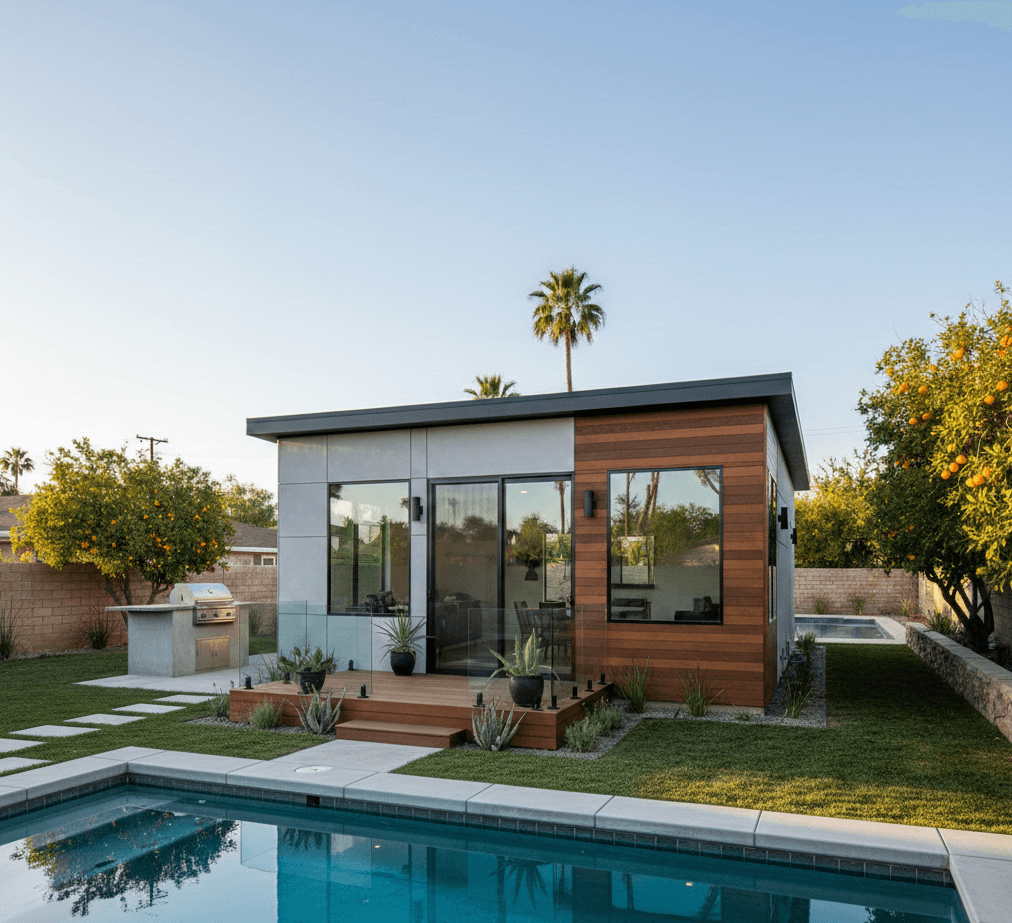
A detached ADU is a freestanding structure built separately from the main home — the most flexible option architecturally, but typically the most expensive. An attached ADU shares at least one wall with the primary residence and can be more cost-efficient on constrained lots. A garage conversion repurposes an existing structure, often making it the most economical path — though fire separation, insulation, and ceiling height requirements add complexity.
Which type makes sense depends on your lot configuration, HOA restrictions (if applicable), how you intend to use the space, and your budget. A general contractor experienced in ADU construction should walk you through the tradeoffs before you commit to a design.
The Permitting Process in Riverside and San Diego Counties
Despite state-level reforms, the permitting experience varies by jurisdiction. Temecula, Murrieta, and Fallbrook each have their own submittal requirements, plan check timelines, and inspection procedures. San Diego County unincorporated areas have their own process separate from the City of San Diego. Orange County cities — Anaheim, Santa Ana, Laguna Niguel — each differ as well.
Working with a contractor who has pulled permits in your specific jurisdiction matters. Familiarity with local plan check comments, fire department requirements, and utility connection procedures can reduce approval timelines by weeks.
What a Home Addition Involves (Beyond the Foundation)
A home addition — whether a bedroom, a great room, or a full second story — touches nearly every trade: foundation work, framing, roofing, electrical, plumbing, HVAC, insulation, drywall, flooring, and finish carpentry. The general contractor's role is to coordinate all of these trades in the right sequence, ensure each phase passes inspection, and deliver a finished product that feels like an intentional part of the original home — not an obvious tack-on.
The most common failure point in addition projects isn't the construction itself — it's the transition detail. Where the new roof ties into the existing roof, where the new flooring meets the old, where the paint colors and trim profiles diverge. A contractor with an eye for these transitions finishes additions that feel cohesive.
What Does an ADU or Addition Actually Cost in Southern California?
Cost ranges vary significantly based on size, finish level, site conditions, and the specific jurisdiction. As a general reference, detached ADUs in Southern California typically range from $150,000 to $350,000 or more for a fully finished unit. Attached additions vary widely but often fall in the $200 to $400 per square foot range for turnkey work including permits and fees.
The most accurate number comes from a contractor who has reviewed your site, your plans, and your local permit requirements. Be cautious of estimates generated without that site-specific context.
Architecture and Design: Getting It Right Before Breaking Ground
Haven Home offers architecture and design services alongside construction, which means the project can be managed as a single, coordinated effort. Plans developed in-house are designed with constructability in mind from the start — reducing the back-and-forth between a separate architect and the build team that often causes delays and cost overruns.
Interested in adding an ADU or home addition? Call Haven Home at 951-621-8088 to talk through your options.
You Also Might Like